Project Overview
During the three-year transition period to certified organic production, producers can face many challenges relating to implementing a more diverse crop rotation, controlling weeds, and maintaining cash crop yields. Many organic producers rely on tillage for weed control, amendment incorporation, and seedbed preparation. Organic producers in regions with hot/humid climates can experience additional management challenges. To study these challenges during the transition-to-organic period, research was conducted in Tennessee using four organic grain systems that varied in tillage, cover cropping, and fertility management practices, as well as crop rotational sequence.
Farmer Takeaways
- Tillage intensity can be reduced in organic corn/soybean/winter wheat systems without cash crop yield reductions if producers take care to effectively terminate the preceding cover crop.
- Cover crop biomass production should be optimized to achieve greater weed control.
- Row cleaners should be used when possible to permit successful soybean establishment in high cover crop residue.
Project Objectives and Approach
Assess the impacts of different cropping systems during the three-year transition period to organic production, based on varying types of tillage, cover crops, fertility sources, and crop rotational sequences
- A 3-year rotation of corn-soybean-winter wheat was established in a full-entry design, in which all three crop phases were present each year, and placed in a split-plot randomized complete block design with four replicates. The cash crop was the main plot level, and the split-plot was the different treatments, described below.
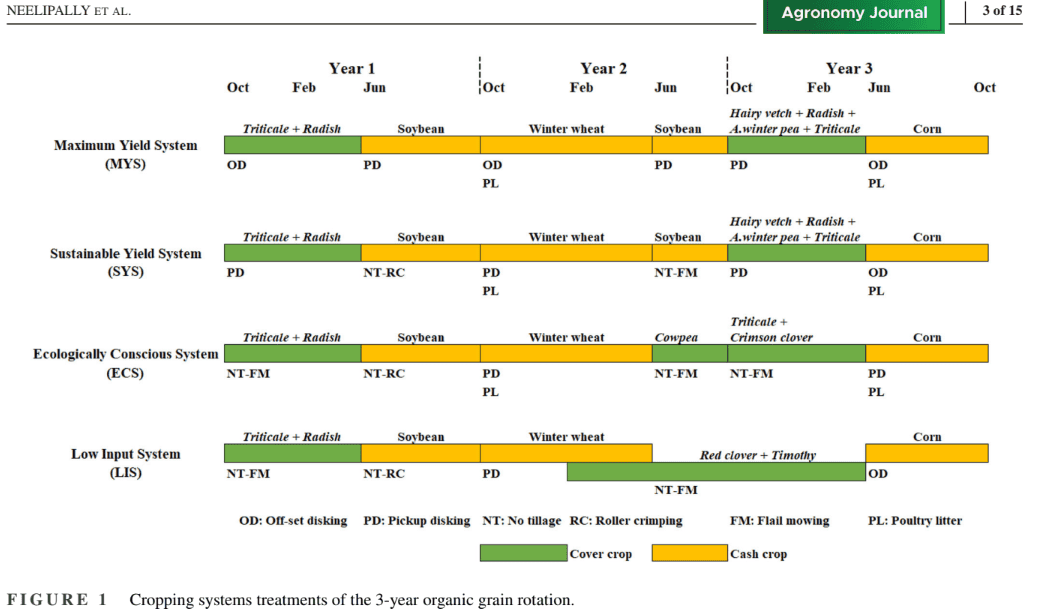
- The four unique treatments were used to assess different goals, and differed in tillage method, cover crop species, and fertilization to meet these goals. Due to the complexity of these different systems, more information can be found in Figure 1 of the paper. The unique treatments were as follows:
-
- Maximum Yield System (MYS): system designed for yield maximization
- Sustainable Yield System (SYS): system designed to balance yield and ecological benefits
- Ecologically Conscious System (ECS): system designed to maximize ecological benefits
- Low Input System (LIS): system designed without external fertility inputs
-
- Tillage methods used in the study included off-set disking, pickup disking, or no-till.
- Cover crop species were chosen to reflect the goals of the treatment; for example, red clover+timothy was selected in the LIS to supply high amounts of N before corn. Cover crops were terminated with either roller crimping or flail mowing.
Evaluate how these various organic cropping systems and climatic variability interactively influence cover crop growth and cash crop yield
- Soil moisture and soil nitrate were measured annually using soil cores, and precipitation and growing degree days (GDD) were recorded annually.
Key Findings
The study mimicked potential ways to transition a typical corn-soybean-wheat rotation to organic production, and highlighted that it is possible to reduce tillage intensity without compromising yield, with the caveat that cover crop management/termination should be strategic
- The maximum yield (MYS) and sustainable yield (SYS) treatments resulted in the highest cover crop biomass (~3x) and greatest weed suppression (~50%).
- The low input (LIS) treatment had the lowest cover crop biomass, lowest weed suppression, and lowest cash crop yields.
- Grain yields in the reduced-tillage and ecologically conscious (ECS) treatments were similar to those of the maximum yield (MYS) treatment, which had intensive tillage, suggesting that tillage can be reduced without compromising yield.
- The researchers recommend the use of row cleaners in reduced-tillage systems, which permits successful cash crop establishment in high cover crop residue.
Annual precipitation and growing degree days (GDD) were not found to be strongly correlated with the outcomes in each cropping system, but soil moisture and soil nitrate were
- Soil moisture and soil nitrate (NO3-) at the vegetative stage of the cash crops were found to be major factors influencing yield.
- Excessive soil nitrate encouraged weed growth as well as crop growth, which accelerated the depletion of soil moisture and intensified weed competition. This highlights the importance of careful fertility management and conserving soil moisture to benefit cash crop yield.
Resources
Neelipally, R.T..K.R., Chhetri, A., Saha, D., Cui, S., & Jagadamma, S. (2025). Agronomic responses of transitioning organic grain rotations employing multi-tactic tillage and cover cropping strategies. Agronomy Journal, 117, e70095.
Read MoreLocation
TennesseeCollaborators
Arjun Chhetri, University of Tennessee
Debasish Saha, University of Tennessee
Song Cui, Middle Tennessee State University
Sindhu Jagadamma, University of Tennessee
Region
Midwest
Topic
Transitioning to Organic, Cropping Systems
Year Published
2025