Project Overview
Weeds pose a significant threat to organic and conventional soybean production systems, causing an estimated annual yield reduction of approximately 44 million metric tons throughout North America. Chemical weed control, while effective, poses risks to the environment and to human health; as such, alternative, NOP-compliant weed control methods are needed.
Propane-fueled flame weeding is one such alternative for organic soybean cropping systems. During flame weeding, propane torches release concentrated thermal energy that damages plant tissue. Previous studies have suggested that flame weeding can be safely conducted in soybean at specific growth stages, including the vegetative emergence to unfolded cotyledon stage (VE-VC), and at the vegetative 4-5 trifoliate (V4-V5) growth stages, for a maximum of two flame weeding treatments per season at a propane dosage of 50kg/ha. However, challenges arise when weeds emerge during flowering, as flame weeding during these stages of crop growth may cause flower abortion and reduce soybean yield.
This study, conducted at the University of Nebraska-Lincoln, investigated the impacts of flame weeding timing (vegetative vs. reproductive), torch height, and propane dose on soybean grain yield.
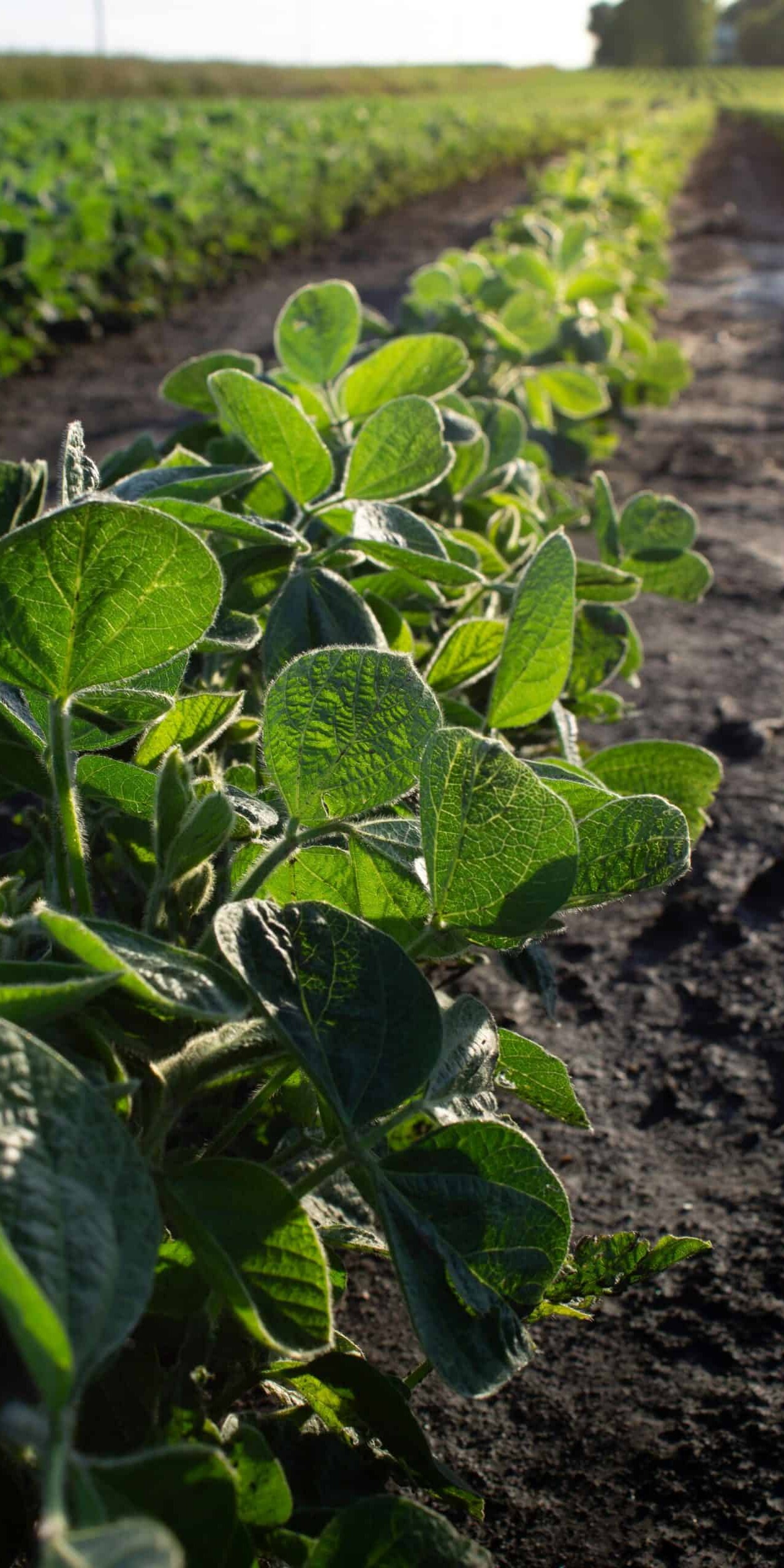
Farmer Takeaways
- Soybean plants may be more prone to damage from flame weeding during the V4 stage, but the research shows that flame-induced injuries to a soybean crop may be temporary.
- At harvest, there were no significant yield differences between any of the flame weeding treatments, suggesting that soybean can be safely flamed at any of the three tested growth stages (V4, R1, or R2).
- Prior studies have identified the critical period for weed control in soybean as spanning from the second trifoliate stage (V2) to the beginning seed stage (R5), with the most significant yield loss from weed interference occurring from R1 onwards. Flame-weeding during the early reproductive stages (R1 and R2) could provide effective weed management during this critical period without compromising soybean yield.
Project Objectives and Approach
To evaluate the impact of flame weeding timing (vegetative vs. reproductive), torch height, and propane dose on soybean grain yield
- Field experiments were conducted in 2022 and 2023 at the University of Nebraska-Lincoln’s Eastern Nebraska Research Extension and Education Center.
- The study was conducted in a randomized complete block design, with a split-split plot arrangement and four replications per year.
-
- The main plot treatments included three soybean crop growth stages during which flame weeding was performed: (1) fourth trifoliate (V4); (2) beginning of flowering (R1); and (3) full flowering (R2).
- The subplot treatments included two flame weeding torch heights: (1) 15cm and (2) 23cm from ground.
- The sub-subplot treatments included five propane doses: (1) 0kg/ha, (2) 28kg/ha, (3) 37kg/ha, (4) 47kg/ha, and (5) 59kg/ha.
-
- Soybean was planted during the second week of May. Plots were maintained weed-free via hand-weeding throughout the season in order to eliminate confounding effects from weeds on the soybean crop’s tolerance to flame weeding.
- Flame-weeding was performed utilizing a tractor-pulled four-row weed flamer (Agricultural Flaming Innovation, Lincoln, NE) equipped with shields positioned above the torches to direct thermal energy to the bottom of crop canopy.
- Following each flaming session, crop visual injury was assessed at 7 and 28 days after treatment on a 0% (healthy plant) to 100% (completely dead plant) scale. Data was collected on soybean grain yield and yield components (number of pods per plant, number of seeds per pod, and 100 seed weight).
Key Findings
Soybean injury and dry matter was influenced by propane dose and crop growth stage, with higher injury scores and lower dry matter observed at the V4 vegetative growth stage and with higher propane doses.
- At 7 days after flaming, crop injury scores increased from 10% to 90% and 7% to 80% for torch heights of 15cm and 23cm, respectively, when propane doses were increased. This suggests that, irrespective of torch height, increasing propane dose may increase the severity of soybean crop injury.
- Higher crop injury and lower plant dry matter was observed when flaming was performed at the V4 vegetative growth stage compared to either reproductive stages (R1 or R2), suggesting that soybean plants may be more sensitive to flame weeding during the V4 stage.
Significant soybean crop recovery was observed by 28 days after flaming, regardless of propane dose, torch height, and crop growth stage.
- By 28 days after flaming, soybean crop injury scores had decreased by between 25% and 45% for the 15cm torch height, high propane dose treatment. Similar trends were observed with other propane doses and torch set-ups, indicating that flame-induced injuries to a soybean crop may be temporary, even for more ‘severe’ initial injuries.
None of the evaluated yield components (grain yield, # of pods per plant, # of seeds per pod, and hundred seed weight) were impacted by flaming treatments.
- Neither grain yield, # of soybean pods per plant, # of seeds per pod, nor hundred seed weight were were significantly different between treatments. This suggests that, despite initial differences in flame-induced crop injuries between the treatments, soybean crops may recover such that that there are no grain yield disparities between treatments at harvest.
-
- Pod numbers ranged from 41-54 per plant, seeds per pod ranged from 2.4-2.6, and grain yield ranged from 3.2-4.2 Mg/ha.
-
Resources
Milosevic, L., Awada, T., Jhala, A. J., Gogos, G., Wortman, S. E., & Knezevic, S. Z. (2025). Flame weeding in soybean: Crop tolerance confirmed during flowering stage. Organic Agriculture, 15(1), 91–106.
Read MoreLocation
NebraskaCollaborators
Tala Awada, University of Nebraska-Lincoln
Amit Jhala, University of Nebraska-Lincoln
George Gogos, University of Nebraska-Lincoln
Sam Wortman, University of Nebraska-Lincoln
Stevan Knezevic, University of Nebraska-Lincoln
Region
Plains
Topic
Weed Management
Category
Grain and Field Crops
Year Published
2025