Project Overview
Organic fruit growers rely on environmentally-acceptable pest management materials to protect their delicate crops. Such materials can sometimes be challenging to find, especially when growers are looking for reliable and effective options. Because many organic materials lack the targeted, selective mode of action of synthetic pesticides and therefore have multiple labeled uses, it can be difficult to sort out how a particular organic pesticide affects a specific pest or the cash crop to which it is applied.
Kaolin clay, sold as Surround WP, is one organic pesticide that is known to be effective against multiple pests and potentially have alternative horticultural uses. Kaolin clay is nontoxic, and it creates a particle film that coats plant surfaces while washing off with rain or after harvest. Kaolin clay is widely used in certain horticultural systems, where producers use it to create an inhospitable environment for insects. The clay particles are uncomfortable for insect pests moving across foliage or fruit surfaces. It also has labeled uses against certain plant diseases and for reducing heat stress.
Kaolin clay has the potential to improve organic winegrape production in several ways. First, it could help organic grape growers deal with important pests like the western grape leafhoppper. Second, kaolin clay could help protect grape crops from sunburn, a type of physical damage where the skin of grape berries is damaged by high temperatures and light intensity, resulting in yield reductions and wine quality issues. Researchers in the Columbia Basin established field trials to evaluate the efficacy of kaolin clay for western grape leafhopper control and sunburn management in winegrapes, with the goal of demonstrating the multiple uses of this organically-approved amendment.
Farmer Takeaways
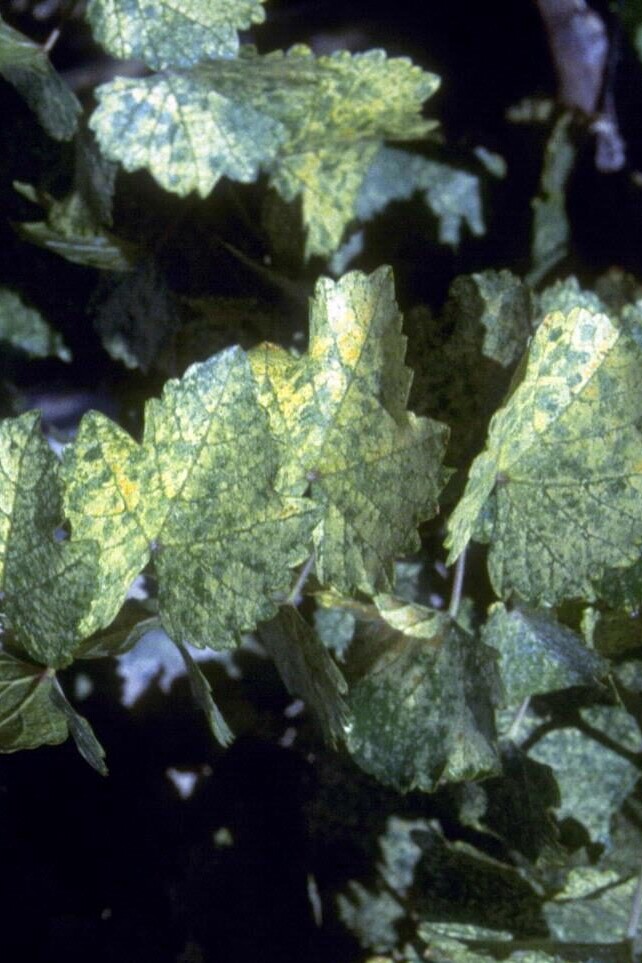
- Kaolin clay applied every three weeks to winegrape canopies following fruit set reduced western grape leafhopper peak populations.
- Leafhopper adult populations were not affected, but nymph abundance was reduced in both years. Adults and nymphs both cause damage, but nymph abundance is a more representative measure of management efficacy.
- When applied to grape clusters ahead of extreme heat events, kaolin clay reduced berry shrivel, sunburn browning, and sunburn necrosis. These results differed between grape varieties, but demonstrated sunburn protection both pre- and post-veraison.
Project Objectives and Approach
Evaluate the efficacy of kaolin clay applications for managing western grape leafhopper in winegrapes
- Researchers in Columbia River Basin, Oregon, established a field experiment in 2023 to test kaolin clay as a control material for western grape leafhoppers, an important insect pest that feeds on grape leaves and creates sticky residue that can lead to diseases.
- Kaolin clay was applied with a backpack sprayer to both sides of the grape canopy at a rate of 25 lbs per acre. Applications began after fruit set and continued on a three week interval until after veraison (the onset of ripening in grapes), for a total of three applications each year. Nontreated control plots were also established in the same vineyard.
- Leafhopper populations were monitored using separate methods for adults and nymphs. Researchers monitored adults using yellow sticky traps in the grape canopy, while they monitored nymphs by collecting grape leaves and immediately using a microscope to count individual insects.
- Researchers submitted juice and berry samples to a commercial laboratory to test important juice quality parameters including total soluble solids, pH, titratable acidity, tannin concentration, and anthocyanin concentration.
Assess kaolin clay as a potential management practice to reduce sunburn damage by protecting grapes from extreme heat and sunlight intensity
- The researchers created a similar small plot field experiment to compare sunburn damage in vines treated with kaolin clay against nontreated vines. This experiment was replicated in two different variety blocks each year. In 2023, the experiment was performed on Tempranillo and Syrah varieties, while in 2024, the experiment was performed on Mourvèdre and Syrah (the Tempranillo block was replaced due to winter injury).
- Kaolin clay was applied to grape clusters only using a backpack sprayer. The application consisted of 50 lbs per acre kaolin clay along with a surfactant. Applications were made ahead of extreme heat events in each year of the study. The first application was made in mid-August 2023, after veraison, while the second year’s application was made in early July 2024, ahead of veraison.
- Researchers evaluated sunburn on the grape clusters about 10 days following treatment by counting damaged berries. At harvest, researchers also analyzed juice quality using the same parameters described above.
Key Findings
Kaolin clay can reduce western grape leafhopper populations, though more research is needed to assess kaolin clay efficacy against high leafhopper populations
- Kaolin treatments reduced second-generation nymph abundance by 54% in 2023 and 80% in 2024. This generation of insects was present in July and into August, depending on insect emergence each year.
- Kaolin clay did not affect the populations of adult leafhoppers in either year of the study. Adult leafhoppers are large insects that can fly across vineyard blocks, so this effect could scale differently if treatments are applied to larger areas.
- Observed leafhopper abundance was low in this study compared to other studies. Notably, leafhopper populations were below typical action thresholds for grapes. While kaolin clay worked well at these low populations, more research is needed to understand if this effect would remain economically-meaningful pest populations.
Kaolin clay can be a useful tool for protecting grape clusters from extreme heat and sunlight, thereby reducing sunburn symptoms
- Kaolin clay reduced shriveled berries when applied post-veraison and reduced sunburn browning and necrosis when applied pre-veraison.
- Kaolin clay did not reduce sunburn in every variety, with Syrah showing fewer sunburn symptoms overall and less response to kaolin clay than either Tempranillo or Mourvèdre. When it was effective, kaolin clay reduced sunburn symptoms by over 50%.
- Effects of kaolin clay on juice quality varied across varieties. Effects on juice quality also differed across years, and more research is needed to understand if kaolin clay applications have any consistent effects on wine quality.
Resources
Copp, C. R. (2025). Kaolin Clay Reduces Western Grape Leafhopper (Erythroneura elegantula Osborn) Abundance and Fruit Sunburn in Warm-climate Vineyards.
Read MoreCopp, C. R., Liao, M., & Bouranis, J. A. (2025). Response of Leaf Optical Properties, Temperature, and Physiology to Variable Kaolin Application Rate. American Journal of Enology and Viticulture, 76(1).
Read MoreLocation
OregonCollaborators
Region
Northwest
Topic
Disease Management, Insect/Pest Management
Year Published
2025