Project Overview
Ground cover management is an important tool for managing crop quality and sustainability within organic vegetable production systems. In order to improve productivity and eliminate weeds, many organic growers use plastic mulch underneath their cash crops. Especially in semi-arid environments where plastic mulch provides significant soil moisture advantages, growers can use an integrated system where raised beds are formed at the same time as plastic mulch and drip irrigation are laid. However, this system requires specialized equipment and raises questions about the sustainability of widespread use of plastic in agriculture.
Cover crops are a valuable alternative to plastic mulches, potentially reducing weed competition while providing important benefits to soil health. Various cover crop systems exist, including living mulches that grow underneath the cash crop and cover crops that create mulch with their residues when terminated ahead of cash crop planting. Understanding how these different approaches affect soil health compared to plastic mulch could help organic vegetable growers make informed vegetation management decisions.
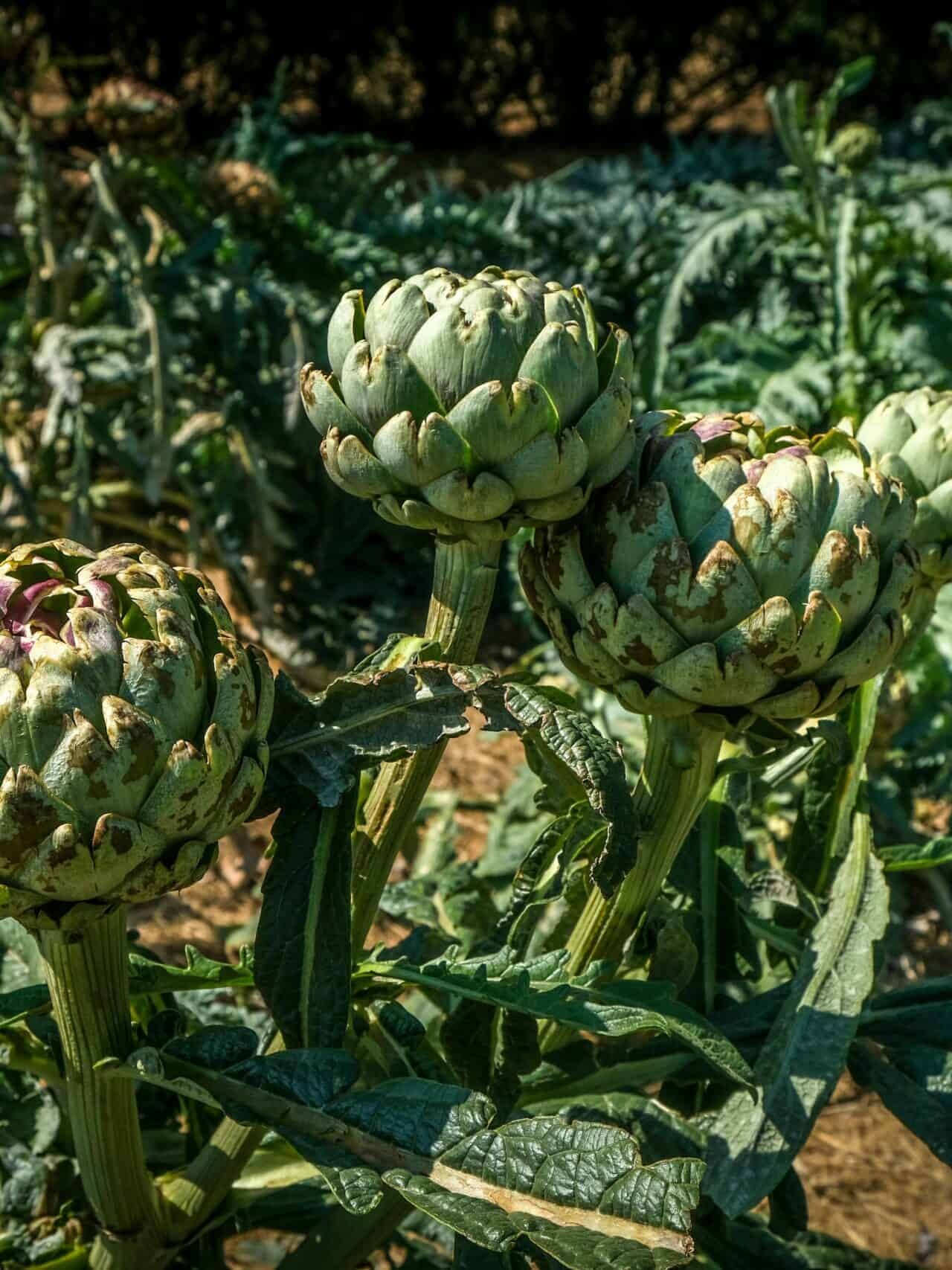
Beginning in 2022, researchers at the Rodale Institute California Organic Center evaluated plastic mulch against three living mulch species and a crimped cover crop mulch in a small plot field experiment. The living mulch included an annual clover, a perennial clover, and a novel perennial ground cover species. The cash crop in this field experiment was globe artichoke, a perennial vegetable crop.
Farmer Takeaways
- All cover crop treatments generally improved soil health compared to the plastic mulch treatment.
- Perennial white clover provided the most benefits to soil health, because it emerged quickly, suppressed weeds, provided continuous ground cover, and increased soil organic matter (SOM). However, all three living mulch treatments resulted in lower artichoke yields.
- Different cover crop treatments provided distinct benefits based on plant lifespan and life cycle.
Project Objectives and Approach
Compare five different mulching systems for ground cover management in an organic globe artichoke production system
- Researchers established a small-plot field experiment in coastal California, where globe artichokes were grown under five distinct ground cover systems. Ground cover systems included: (1) plastic mulch, (2) annual crimson clover living mulch, (3) perennial white clover living mulch, (4) perennial Kurapia (Lippia nodiflora), and (5) a buckwheat-pea mulch, which was terminated via roller-crimper prior to artichoke transplanting.
- Plots were established in the spring of 2022, and artichokes were planted in October 2022. Researchers monitored the plots for two years, harvesting artichokes continuously during the springs of 2023 and 2024 in alignment with commercial harvest practices.
Evaluate the soil health outcomes, including effects on carbon and organic matter, soil moisture, and soil nutrients, for the different mulching systems
- Throughout the study, researchers evaluated multiple soil health outcomes, including pH, soil organic matter (SOM), organic carbon, microbially active carbon, inorganic N, and soil respiration.
- Soil water parameters were measured in the field and included soil moisture, soil temperature, and infiltration rate.
- Aboveground biomass of weeds and mulches was evaluated using quadrat sampling at multiple time points across the experiment.
Key Findings
Living mulch systems provide varying benefits to soils and are influenced by the mulch plant species’ lifespan (i.e. perennial vs. annual) and life cycle (i.e., time until perennial crop maturation)
- Perennial White Clover: White clover provided continuous living cover throughout the study, which resulted in relatively higher levels of soil nutrients and soil organic matter (SOM) compared to other mulching treatments.
- Crimson Clover & Buckwheat-Pea Mulch: Both of these mulching systems decomposed in the second year of the study, and subsequently provided fewer benefits. The crimson clover naturally aged/died off, owing to its properties as an annual crop, while the buckwheat-pea mulch broke down quickly following artichoke planting.
- Perennial Kurapia: Kurapia is a novel, low-growing, perennial broadleaf groundcover species developed as an eco-friendly alternative to turfgrass. In this study, Kurapia was established via plug transplants in spring 2022. After Kurapia became better-established in the second year of the study, it became more competitive, both with weeds and the artichoke crop itself.
Plastic mulch retained the most soil moisture, but did not seem to provide other benefits to soil health
- All three of the living mulch treatments (annual crimson clover, perennial white clover, & perennial Kurapia) resulted in lower soil moisture compared to the plastic mulch treatment throughout the experiment. The buckwheat-pea mulch resulted in intermediate soil moisture values.
-
- Plastic mulch reduced water infiltration rates and increased soil temperature compared to other treatments, suggesting that, while mulching with plastic may increase irrigation efficiency, it may not contribute to other measures of soil health.
-
Across the two years of this experiment, both of the living clover mulches (annual crimson clover and perennial white clover) resulted in lower artichoke yield than other treatments
- Perennial white clover and annual crimson clover both significantly reduced artichoke yield, highlighting potential tradeoffs between soil health and short-term crop yield.
- As Kurapia become more established in the second year of the study, it marginally reduced artichoke yields, resulting in a yield between the lower yields of the clover treatments and the higher yields from both the plastic mulch and the rolled buckwheat-pea mulch treatments.
- Both of the clover treatments resulted in slightly increased artichoke yield in year 2 compared to year 1, while the other three treatments (plastic, Kurapia, and buckwheat-pea mulch) had significant year-over-year yield reductions.
Resources
Bozzolo, A., Pecenka, J., Hamido, S., & Acharya, B. (2025). Living mulches, crimped cover crops, and plastic mulch influence on soil health, weed suppression, and yield in organic globe artichoke systems. European Journal of Agronomy, 170, 127759.
Read MorePecenka, J., Bozzolo, A., & Smith, A. (2025). High-Residue and Reduced Tillage Enhances Soil Fertility, Weed Suppression, and Crop Yield in Organic Vegetable Systems. Sustainability, 17(17), 8069.
Read MoreBozzolo, A., Pecenka, J., & Smith, A. (2025). Living Mulches, Rolled Cover Crops, and Plastic Mulch: Effects on Soil Properties, Weed Suppression, and Yield in Organic Strawberry Systems. Plants, 14(21), 3385.
Read MoreLocation
CaliforniaCollaborators
Jacob Pecenka, Rodale Institute California Organic Center
Said Hamido, Rodale Institute
Bharat Acharya, Rodale Institute
Region
West/Southwest
Topic
Soil Health, Crop Nutrient Management, Weed Management, Cropping Systems
Year Published
2025