
Project Overview
Vermicompost is a fertilizer material and soil amendment produced during the decomposition of organic material by earthworms. Vermicompost is known to be rich in plant-available nutrients and can be produced relatively quickly and at lower temperatures than other types of compost.
However, like most organic fertilizers, vermicompost can be expensive, and calculating application rates based on vermicompost mineralization rates (the rates at which nutrients become available for uptake by plants) can be difficult. Vermicompost tea, produced by ‘steeping’ vermicompost in water, may serve as a viable, cost-effective alternative to solid vermicompost, providing immediate nutrients to crops (since vermicompost tea contains only the extracted, water-soluble/plant-available nutrients) when applied as a foliar fertilizer.
Both vermicompost and vermicompost tea can be beneficial to organic farmers, but additional information is needed on ‘best-practices’ and residual effects for these organic fertilizers. Beginning in 2022, researchers in Florida applied different vermicompost and vermicompost tea combinations to a corn crop, before planting a winter strawberry crop the following fall. By evaluating productivity of the subsequent strawberry crop grown without additional fertilizers, the researchers were able to assess the residual effects of vermicompost fertilizers across double-crop growing seasons.
Farmer Takeaways
- Applying a moderate rate (~1 ton/acre) of solid vermicompost one growing season prior to a strawberry crop may provide carryover nutrient benefits, improving strawberry fruit yield and quality over strawberries grown after a season of traditional mineral fertilization.
- Applying vermicompost at higher rates (~3 tons/acre) increases soil salinity, which may severely inhibit strawberry growth and development in subsequent growing seasons. Producers should strive to understand the nutrient composition of their vermicompost before applying it to a crop.
- Vermicompost teas did not perform better than solid vermicompost.
Project Objectives and Approach
Evaluate soil nutrient carryover from vermicompost/vermicompost tea applications for successive growing seasons in an organic corn-strawberry double crop system
- Researchers from Florida International University (Miami, FL) established a field experiment to assess how vermicompost fertilization (type and application rate) impacts nutrient carryover from a summer corn crop to a winter strawberry crop.
-
- Vermicompost Fertilization Treatments: (1) control/traditional 8-4-8 organic fertilizer, applied twice per growing season at 0.3 tons/acre; (2) 1 ton/acre vermicompost; (3) 1 ton/acre vermicompost + vermicompost tea; (4) 3 tons/acre vermicompost; (5) 3 tons/acre vermicompost + vermicompost tea; and (6) vermicompost tea only.
-
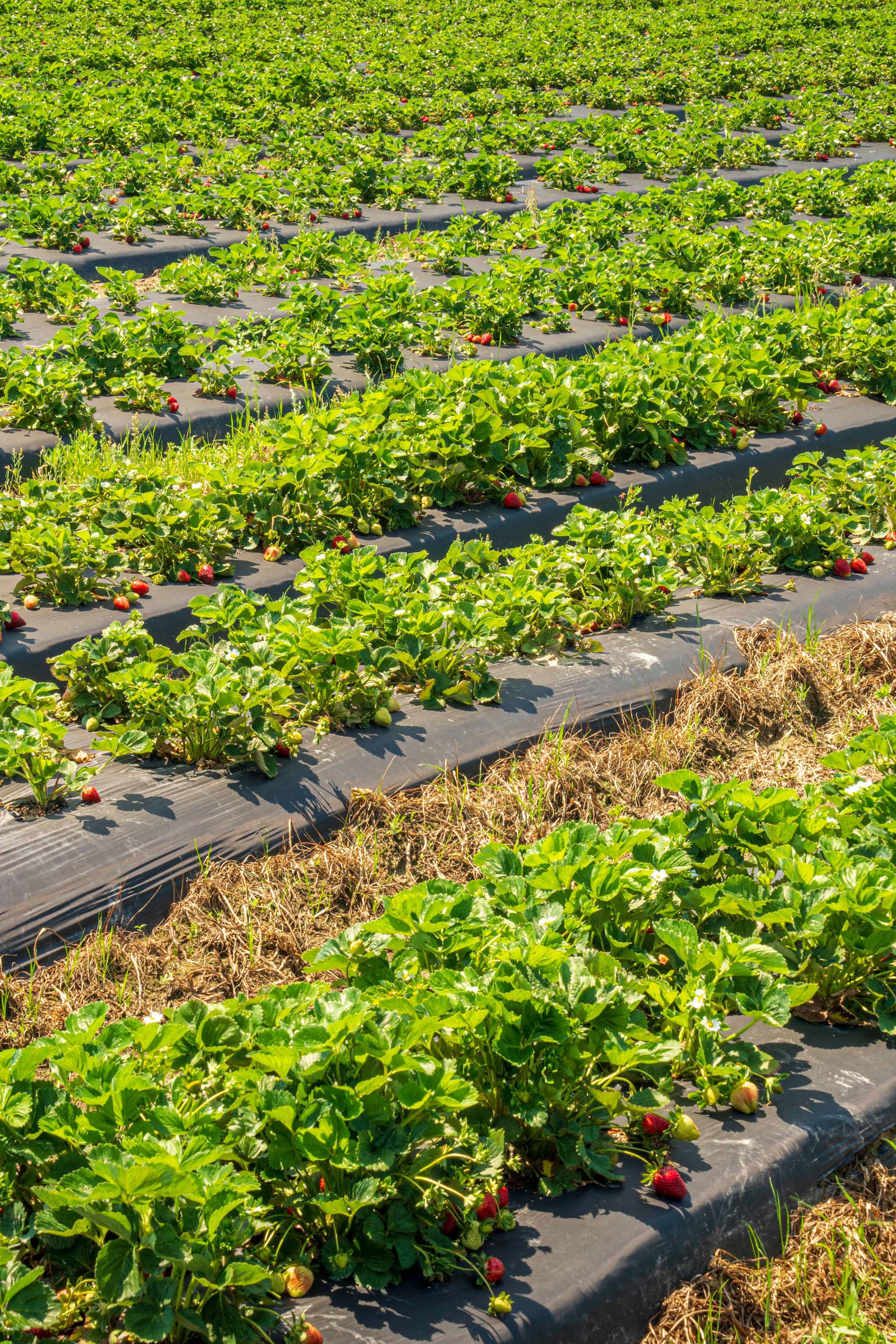
- Corn plots received one of the six vermicompost fertilization treatments. Following corn harvest, strawberries were planted in each of the experimental plots in raised beds covered with cloth mulch. Strawberries received no additional fertilizer, since this study evaluated residual nutrients carried over from the preceding (fertilized) corn crop.
- Soil samples were collected at the beginning (November) and end (April) of the strawberry growing season and analyzed to determine soil nutrient concentrations at the 0-4” and 4-8” depth horizons.
Assess the residual effects of vermicompost treatments on strawberry growth, performance, and yield
- Researchers monitored strawberry growth and development, collecting physiological data throughout the vegetative, flowering, and early fruit development stages.
-
- Chlorophyll content, stomatal conductance, and canopy reflectance were recorded with field sensors at weekly time points during the middle of the strawberry growing season.
-
- Towards the end of the growing season, strawberries were harvested continuously, and researchers calculated marketable yield.
- After harvest, whole strawberry plants (roots and shoots) were collected from each plot/treatment, and biomass was measured. Sample plant tissues were dried, ground, and analyzed for nutrient concentrations.
Key Findings
Residual nutrients provided by moderate rates of vermicompost boosted strawberry health and yield, while higher rates damaged strawberry plants
- Strawberry yields for the 1 ton/acre solid vermicompost treatment were nearly double that of the organic fertilizer control treatment and between two to three times higher than yields from the higher-rate vermicompost/vermicompost tea treatments. These findings suggest that applying 1 ton/acre solid vermicompost one growing season prior to a strawberry crop may provide carryover nutrient and yield benefits; conversely, applying higher rates of vermicompost may inhibit strawberry growth.
-
- Vermicompost applied at 3 tons per acre (both with and without vermicompost tea) faced significant growth challenges, and did not produce much marketable fruit. **Note: The researchers postulated that the growth challenges observed under higher rates of vermicompost may have been due to elevated soil sodium concentrations.
-
Resources
Oyege, I., & Balaji Bhaskar, M. S. (2025). Residual Impacts of Vermicompost-Derived Nutrients on a Strawberry–Corn Double Cropping System Under Plasticulture in South Florida. Environments, 12(5), 171.
Read MoreLocation
FloridaCollaborators
Ivan Oyege, Florida International University
Region
Southeast
Topic
Soil Health, Crop Nutrient Management, Cropping Systems
Category
Vegetables/Fruits, Grain and Field Crops
Year Published
2025