Project Overview
Balancing pest control and pollination is a significant challenge in organic vegetable production, particularly for pollinator-dependent crops like cucurbits (cucumbers, melons, squash).
Cucumber beetles, squash bugs, and squash vine borer moths, which are the predominant cucurbit insect pests, can serve as vectors for pathogens responsible for crop diseases like bacterial wilt and cucurbit yellow vine disease (CYVD), which can devastate cucurbit crop yields if not effectively managed. At present, organic insecticide options for cucumber beetles and squash bugs are relatively ineffective, rarely providing control levels exceeding 50%. As such, many organic cucurbit producers have turned to physical pest exclusion tactics, including installing fine-mesh row covers over mesotunnels during the growing season.
However, physical pest exclusion also excludes native pollinators, which are crucial for proper cucurbit fruit development. Several strategies have emerged for managing pollination beneath row covers, but these strategies have been evaluated primarily on small-scale plots. This study, conducted on larger-scale plots at the University of Kentucky, compared the pest control and pollination efficacy of four different row cover management strategies for organic acorn squash.
Farmer Takeaways
- Full-season and open-end row cover strategies may reduce post-flowering cucumber beetle and squash bug numbers.
- Full-season and open-end row cover strategies may reduce pollinator activity compared to on-off and on-off-on row cover strategies, but not by enough to reduce pollination success or marketable yield, which was highest in the open-end treatment.
- An open-end row cover system may be a viable insect pest/disease management strategy for organic cucurbit producers, while allowing for sufficient natural pollination.
Project Objectives and Approach
To compare the pest control and pollination efficacy of four different row cover management strategies (on-off, on-off-on, open ends, and full season) for organic acorn squash
- Field studies were conducted at the University of Kentucky Horticulture Research Farm (Lexington, KY) during two consecutive summers (2020 and 2021).
- Treatment fields were amended at a rate of ~4 tons/ha with organic compost, spaded, and cultivated. Organic ‘Table Ace’ acorn squash seeds were started in a USDA certified-organic greenhouse and grown for four weeks prior to transplanting. Immediately after transplanting, mesotunnels (1m tall) were installed over each treatment, and fine mesh netting was installed over the hoops.
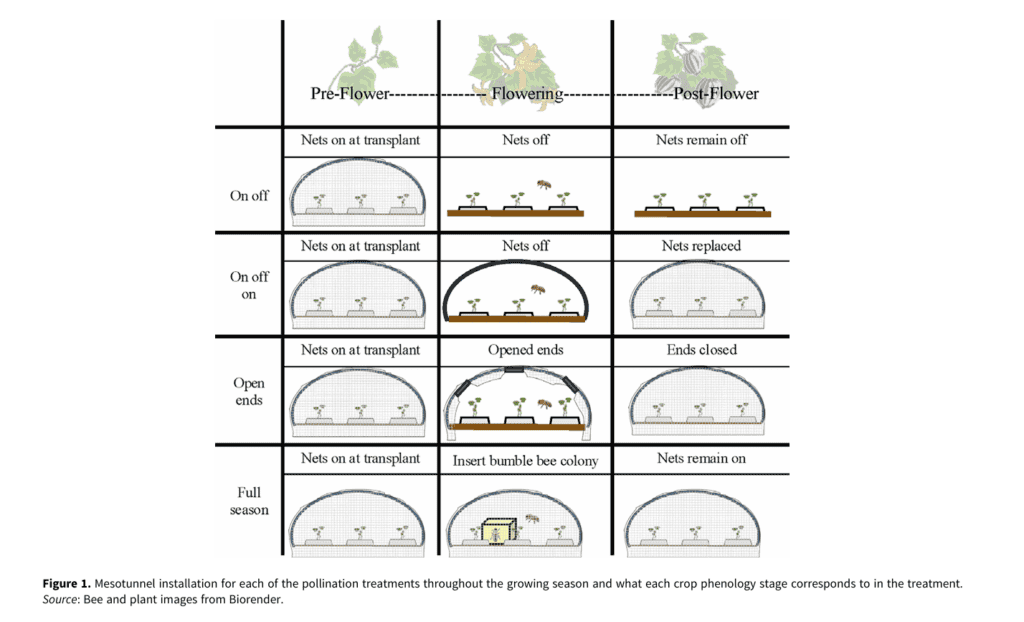
- The four row cover treatments included:
-
- On-Off: Mesotunnels established at planting until flowering. At flowering, nets were removed for the remainder of the growing season.
- On-Off-On: Mesotunnels established at planting until flowering. At flowering, nets were removed and reinstalled once pollination was completed (~3 weeks) for the remainder of the growing season.
- Open Ends: Mesotunnels established at planting until flowering. At flowering, the 6.4m short ends of plots were opened. Following the completion of pollination, the net ends were reclosed for the remainder of the growing season.
- Full Season: Mesotunnels established at planting until flowering. At flowering, one Natupol-Excel bumblebee colony was placed in the center bed at the center of the plot to provide pollination services. Mesotunnels remained covered until harvest.
-
- One week after transplanting, one sticky card was placed 1.5m inward from each plot end in the center bed of each plot and removed after 7 days. A second set of sticky cards were deployed after the completion of pollination and removed after 7 days. All cucurbit insect pests trapped on the sticky cards were identified and quantified.
-
- Additionally, visual plant surveys were conducted weekly beginning one week after transplanting (2021) and at flowering (2020) by assessing six plants per subplot at varying distances from the ends of the row covers. A trained surveyor observed key pests, monitoring for striped and spotted cucumber beetles, squash bug adults, nymphs, and egg clusters.
-
- Pollinator activity was monitored via visual surveys of the same six plants (see above), once weekly during the crop’s flowering period. A trained surveyor monitored the number of flower visitations by squash bees, honey bees, small native bees, and bumblebees. Pollinator activity was defined as the number of bees flying over or present within the survey area during the 45-second survey period.
-
- Sample acorn squash fruits were evaluated for number of seeds per fruit (a proxy for pollination success).
-
- Based on weekly pest survey results, organic insecticides were applied once weekly if pest numbers exceeded action thresholds determined from existing literature/standard management practices.
- At harvest, data was collected from squash harvested at each of the six sampling locations (varying distances from ends of row covers) on fruit number, total fruit weight, and quality.
Key Findings
Cucumber Beetles & Squash Bug Adults, Nymphs, and Eggs
- The number of cucumber beetles sampled using sticky cards did not differ by treatment, but the number of beetles observed during visual surveys did. In both years, the full-season treatment and the open-end treatment had significantly fewer cucumber beetles (across both flowering and post-flowering stages in 2020 and during post-flowering in 2021) than the on-off-on treatment.
- In 2020, the full-season and open-end treatments had significantly fewer squash bugs compared to the on-off-on treatment post-flowering.
Pollinator Activity
- Across both years, bumblebees were the dominant pollinator (>75%), with squash bees, honeybees, and small native bees comprising between ~2 and ~10% of the remaining pollinator activity.
- In 2021, the full-season treatment had significantly fewer total bee observations, despite being stocked with a bumblebee colony, relative to the on-off and on-off-on treatments.
-
- The number of seeds per fruit (an indicator of pollination success) was not significantly different across treatments in 2021, indicating that, despite the observed differences in pollinator activity between treatments, pollination appeared to be successful.
-
Disease
- Wilting symptoms (associated with bacterial wilt and CYVD) were either absent or minimal during both years, with no significant differences between treatments.
Yield
- In 2020, the open-ends treatment had 1.6 and 1.1 times greater marketable yield compared to the full-season and on-off-on treatments, respectively, but did not differ from the on-off treatment.
Resources
Pulliam, K. F., Brockman, R., Avery, C., Gauger, A., Williams, M., Bessin, R., & Gonthier, D. (2026). Balancing row cover pest and pollination management in organic cucurbit production. Renewable Agriculture and Food Systems, 41, e1.
Read MoreLocation
KentuckyCollaborators
Robert Brockman, University of Kentucky
Chelsea Avery, University of Kentucky
Alexis Gauger, University of Kentucky
Mark Williams, University of Kentucky
Ricardo Bessin, University of Kentucky
David Gonthier, University of Kentucky
Region
Midwest
Topic
Disease Management, Insect/Pest Management
Category
Vegetables/Fruits
Year Published
2026