
Making the Transition from Conventional to Organic
Transitioning to organic farming offers both economic and social benefits over conventional methods. For farmers and…

Soil Nutrient Management on Organic Grain Farms in Montana
Discover how soil testing can help maintain soil fertility in organic production by identifying nutrient needs and…

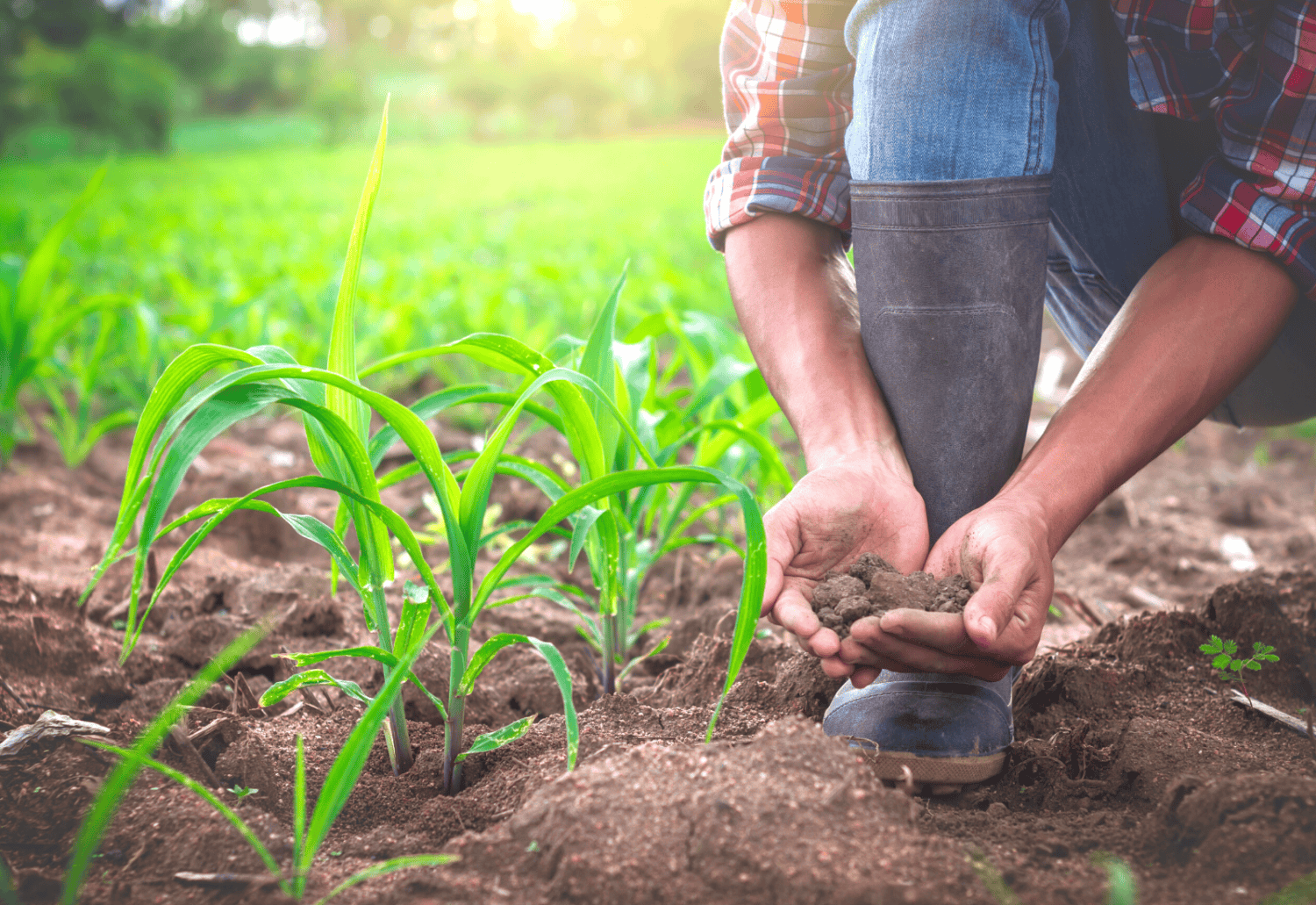
Sustainable Soil Management
This publication covers basic soil properties and management steps toward building and maintaining healthy soils. Part…

No-Till Case Study, Bauer Farm: Cover Crop Cocktails on Former CRP Land
The Bauer family in Bismarck, ND, converted CRP land back to crops to boost nutrient cycling and residue breakdown…

Alley Cropping: Central and Southern Appalachian Region
This factsheet covers alley cropping (NRCS Practice Code 311), an agroforestry practice where you plant trees or shrubs…
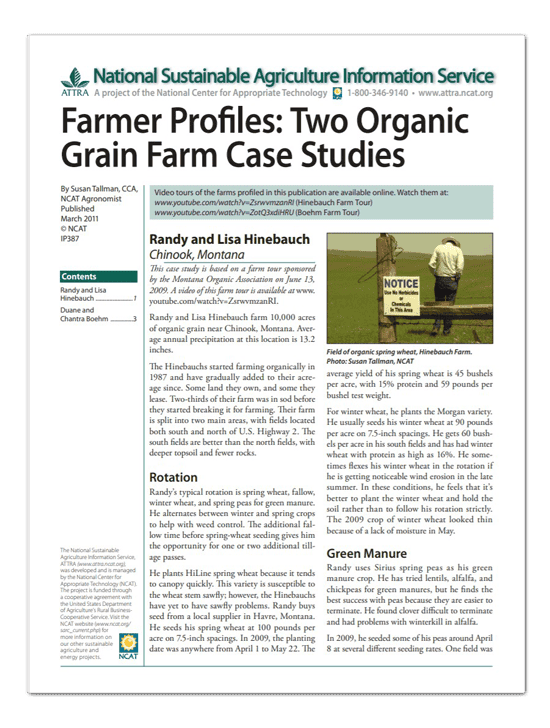
Farmer Profiles: Two Organic Grain Farm Case Studies
This publication highlights two organic grain farmers , the Hinebauchs of Chinook, MT and the Boehm's of Richardton,…
Enhancing insect pest management in organic systems using genotypically diverse cultivar mixtures
Summary Coordinator: John Tooker, Pennsylvania State University Project location: Russel Larson Agricultural…
Evaluation of In-Row Weed Cultivators in Organic Soybeans and Corn
Objectives 1. To investigate the abilities of six in–row weeding implements to control in-row weeds in organic…
Phytoestrogen content of conventionally and organically grown soybeans
Soy-based foods have been the subject of recent research because of growing evidence that soy phytoestrogens might…
Controlling Weeds in Organic Crops Through the Use of Flame Weeders
Several recent developments have resulted in the need for a new examination of flaming as a nonchemical method of…