Project Overview
Interest in organic agriculture is growing steadily in California, with crops including potatoes regularly returning significantly higher prices than conventional. However, maintaining crop yields comparable to those in conventional systems can be a challenge for organic producers – a challenge that often comes down to effective nutrient management, particularly nitrogen, which is limited in many California soils.
Most varieties of potatoes require at least 200 lbs of nitrogen per acre to maximize yield and quality. This nitrogen must be available for uptake throughout the entire growing season: at planting to support vegetative vine growth and tuber set and in mid-summer for tuber bulking. In organic production systems, nitrogen is often supplied in the form of compost, manure, or cover crops, which decompose at varying rates depending on soil moisture, temperature, soil type, and the carbon-to-nitrogen ratio of the organic matter source. Timing this decomposition (and subsequent release of plant-available nitrogen) with nutrient-dependent crop growth stages is challenging.
Researchers from the University of California Agriculture & Natural Resources Intermountain Research and Extension Center conducted several studies between 2014 and 2017 evaluating the influence of cover crops and soil amendments on organic potato crop production.
Farmer Takeaways
- Higher potato petiole nitrate levels at early bulking correlate with healthier, taller, and more vigorous late-season potato plants and greater potato yields.
- Growing legume cover crops the year before a potato cash crop, as well as amending soils with amendments such as chicken manure and bloodmeal can boost petiole nitrate levels, average tuber size, and yields without reducing quality.
- Certain potato varieties (i.e., Russet Norkotah) are more sensitive to cover cropping and soil amendments.
Project Objectives and Approach
Evaluate the impacts of cover crops and organic soil amendments on next-year organic potato crop performance
Cover Crop Study:
- Two cover crop field studies were conducted at the University of California Agriculture & Natural Resources Intermountain Research and Extension Center: one evaluating mid-summer cover crops and another evaluating cover crops planted in spring, mid-summer, and fall.
-
- Cover crop species included cool-season and warm-season species, seeded alone and in mixes. Cover crops were drill-seeded into disked, packed seedbeds and grown under sprinkler irrigation without synthetic fertilizers or pesticides.
- At early flowering, cover crops were flail-mowed and incorporated via disking.
-
- Data was collected on cover crop density, biomass, vigor, weed suppression, and weed biomass. Cover crop samples were sent to a laboratory to estimate total nitrogen content.
- All cover crop treatments were compared to an untreated fallow treatment and a urea treatment.
Organic Soil Amendment Study:
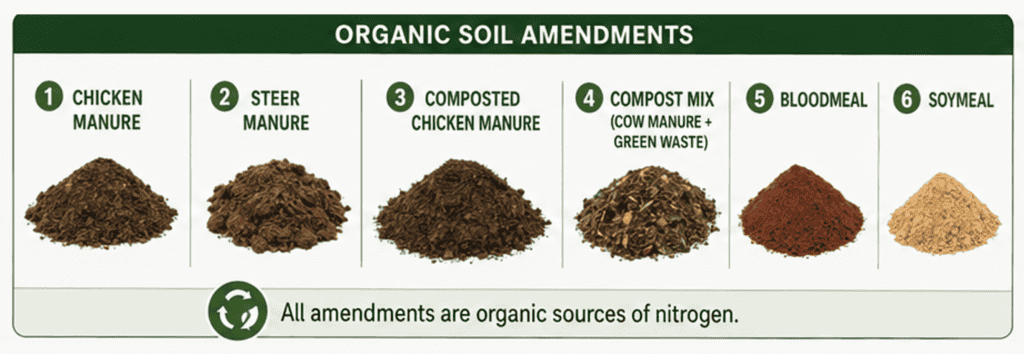
- An organic amendment field study was also conducted. Amendments included: (1) chicken manure, (2) steer manure, (3) composted chicken manure, (4) a compost mix containing cow manure and green waste, (5) bloodmeal, and (6) soymeal.
-
- Amendments were applied by hand and disk-incorporated. Application rates varied, with the goal of applying 150 lbs N per acre.
-
- All soil amendment treatments were compared to an untreated fallow treatment and a urea treatment.
Potato Production:
- Potatoes were planted the year after cover crops were grown, in all treatment plots. No synthetic fertilizers or pesticides were applied. Two potato varieties were evaluated: Russet Norkotah and Yukon Gold.
-
- Pre-plant soil samples were taken to ensure that soils had adequate supplies of phosphorus, potassium, sulfur, and calcium. Pre-plant soil samples were also collected and analyzed for nitrate (NO3-N), ammonium (NH4-N), and total nitrogen content.
- Data was collected on potato crop vigor* and petiole nitrate** at early tuber bulking and at crop maturity.
-
- *Potato crop vigor: measured by visually assessing plant canopy cover, height, and color. Higher vigor scores indicate higher canopies and darker color.
- **Petiole nitrate: a measure used to evaluate in-season nitrogen availability.
-
- Potatoes from each plot were mechanically harvested and graded to determine fresh-market tuber yield and quality.
-
- Post-harvest soil samples were collected and analyzed for available soil nitrate and ammonium.
Key Findings
Cover Crop Study
- Legume cover crops (i.e. field peas, vetches) resulted in significantly higher potato petiole nitrate levels at early bulking than grass cover crops. **Petiole nitrate at early bulking was strongly correlated with potato crop vigor at row closure and tuber initiation, with higher petiole nitrate levels corresponding to taller, greener potato plants.
- Potato yields were higher and average tuber sizes were larger for Russet Norkotah potatoes grown following vetch cover crops. No significant differences in yield or tuber size were observed between treatments for Yukon Gold potatoes.
- None of the cover crop treatments significantly influenced the number of potato tubers with knobs or growth cracks.
- These results suggest that growing a legume cover crop (especially vetches) the year before a potato cash crop may result in healthier, more vigorous late-season plants, larger tubers, and higher yields.
Organic Soil Amendment Study
- Plots amended with chicken manure, bloodmeal, and soymeal resulted in high potato petiole nitrate levels (>19,000 ppm), similar to those observed in potato crops grown after field pea/vetch legume cover crops. Green waste compost and steer manure did not increase potato petiole nitrate.
- Potato yields were higher and average tuber sizes were larger for Russet Norkotah potatoes grown in plots amended with chicken manure (composted and non-composted), steer manure, and bloodmeal. No significant differences in yield or tuber size were observed between treatments for Yukon Gold potatoes.
- None of the soil amendments significantly influenced the number of potato tubers with knobs or growth cracks.
- These results suggest that certain organic soil amendments (i.e., chicken manure and bloodmeal) may improve organic potato crop performance, resulting in larger tuber sizes, higher yields, and healthier late-season plants.
Resources
Wilson, R., Culp, D., Peterson, S., Nicholson, K., & Geisseler, D. (2019). Cover crops prove effective at increasing soil nitrogen for organic potato production. California Agriculture: The Journal of UC Agriculture and Natural Resources, 73(2).
Read MoreLocation
CaliforniaCollaborators
Darrin Culp, University of California Agriculture & Natural Resources
Skyler Peterson
Kevin Nicholson, University of California Agriculture & Natural Resources
Daniel Geisseler, University of California Agriculture & Natural Resources
Region
West/Southwest
Topic
Crop Nutrient Management, Cropping Systems
Year Published
2019