Project Overview
Cover cropping has been established as an effective, sustainable strategy for improving soil health, reducing N leaching and soil erosion, and promoting microbial activity/nutrient cycling, and managing weeds. In the Midwestern region of the United States, it is estimated that ~60% of agricultural land has the potential to support cover crops (Kladivko et al., 2014); however, at present, less than 20% of that land is currently planted with cover crops following a cash crop (i.e., corn) harvest.
In addition to providing soil health benefits, cover crops can serve as an important source of forage for livestock, especially during colder months. Alternative grazing systems, which incorporate winter cover crops, may be useful for achieving a longer grazing season and maximizing forage production.
This study, conducted between 2015 and 2019 by the University of Minnesota, evaluated the interacting effects of winter cover crops and cattle grazing in rotation with organic corn or soybean on the balance and dynamics of soil fertility and soil enzyme activity.

Farmer Takeaways
- Grazing cattle on winter cover crops may enhance certain soil nutrients, build soil C, and stimulate soil microbial activity/nutrient cycling; however, precautions should be taken to ensure that resulting excess nutrients (i.e., NO3-, NH4+) do not leach into nearby waterways.
- Soil properties differed depending on cover cropping system. The rye cropping system, which resulted in lower overall nitrate (NO3-) levels than the winter wheat/vetch system, may be able to offset some of the excess NO3- observed in the cattle treatments, suggesting that specific cover crops may enhance the overall sustainability of grazed crop/livestock rotations.
Project Objectives and Approach
Evaluate the interacting effects of several winter cover crops (winter wheat, vetch, rye), with and without early-spring rotational cattle grazing on soil fertility and soil enzyme activity in organic corn/soybean production systems
- Field studies were established at the University of Minnesota West Central Research and Outreach Center (Morris, MN) and at the Rodale Institute (Kutztown, PA) between 2015 and 2019.
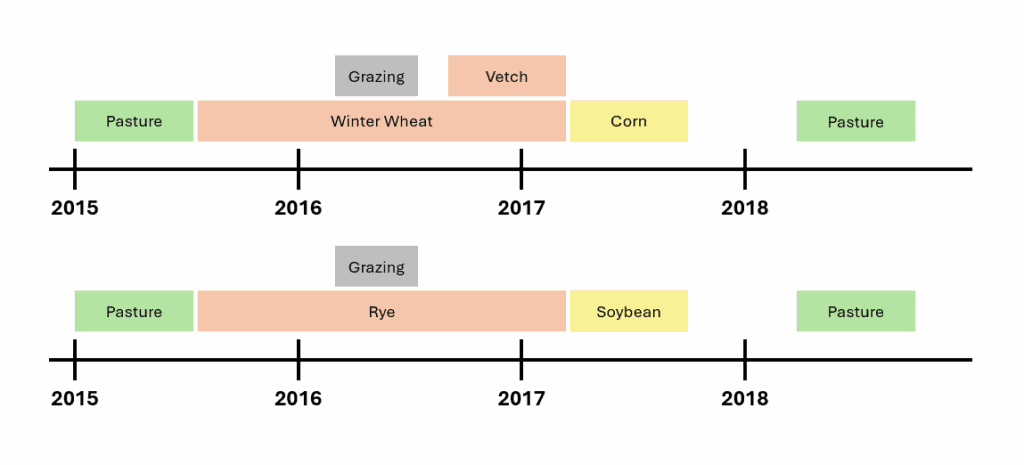
- Grazing treatments included: (a) presence of early-spring rotational cattle grazing, and (b) absence of cattle grazing. Cropping system treatments included two rotations: (a) pasture-rye-soybean-pasture, and (b) pasture-winter wheat/vetch-corn-pasture (see timeline below). Manure from cattle during the grazing season fertilized pastures in this study. No additional fertilizer was applied to the corn, soybean, or pasture crops.
- Soil samples were collected at each pasture prior to cover crop planting, and then again five times during the study. Soil properties analyzed included: soil pH, organic matter, salinity, K, Ca, Mg, cation exchange capacity, Bray-1, beta-glucosidase, alkaline phosphatase, aryl sulfatase, fluorescein diacetate hydrolysis, ammonium (NH4), nitrate (NO3), permanganate oxidizable carbon, N%, C%, S%, and C:N ratio.
- Pastures with cattle grazing were divided into seven 0.57-ha paddocks in order to implement rotational grazing methods, with a stocking rate of 4-5 steers per paddock. Grazing was initiated when forage height reached 15cm (April 2016). Steers were randomly assigned to graze either of the two cropping systems. Rotations through paddocks took place every 3 days, from April-June 2016.
Key Findings
Early-season rotational cattle grazing significantly impacted many soil properties in both cropping systems.
- Treatments with cattle grazing tended to have increased glucosidase* activity, available Ca, Mg, NO3-, NH4+, soil pH, soil C%, S%, and C:N ratios. These findings suggest that incorporating rotational cattle grazing into the winter cover crop stage of an organic crop rotation may enhance certain soil nutrients, build soil C, and stimulate soil microbial activity; subsequently, it is important that farmers take appropriate measures to prevent excess nutrient runoff.
-
- *glucosidase (specifically, beta-glucosidase) is a key indicator of microbial activity, carbon cycling, and overall soil health. Higher glucosidase levels generally signify higher microbial biomass, healthy nutrient cycling, and better soil quality.
-
Cover cropping system also significantly impacted soil properties, with potential implications for sustainably managing excess nutrients from cattle grazing.
- The winter wheat/vetch cropping system tended to have higher soil pH, available Ca, NO3-, and sulfatase activity compared to the rye cropping system.
- The rye cropping system tended to have higher soil organic matter (SOM), available K, Mg, cation exchange capacity (CEC), glucosidase, phosphatase, POXC, and total C%, N%, and S% compared to the winter wheat/vetch cropping system.
-
- Grazing cattle in the rye cropping system resulted in lower soil NO3- levels than grazing cattle in the winter wheat/vetch cropping system, suggesting that cover crop type can influence and offset some of the increased NO3- levels observed in cattle treatments.
-
- The higher concentrations of SOM observed in the rye cropping system, together with greater glucosidase and phosphatase levels, suggest that – although more organic matter was available, the quality may have been worse than that of the winter wheat/vetch cropping system, resulting in a slower rate of decomposition. These results indicate that there may have been quality differences in the organic matter of each cropping system.
Resources
Galindo, F. S., Delate, K., Heins, B., Phillips, H., Smith, A., & Pagliari, P. H. (2020). Cropping System and Rotational Grazing Effects on Soil Fertility and Enzymatic Activity in an Integrated Organic Crop-Livestock System. Agronomy, 10(6), 803.
Read MoreKladivko, E.J.; Kaspar, T.C; Jaynes, D.B; Malone, R.W; Singer, J; Morin, X.K; Searchinger, T. (2014). Cover crops in the upper midwestern United States: Potential adoption and reduction of nitrate leaching in the Mississippi River Basin. Soil Water Conserv. 69, 279-291.
Read MoreLocation
Minnesota, PennsylvaniaCollaborators
Fernando Shintate Galindo, Sao Paulo State University
Kathleen Delate, Iowa State University
Bradley Heins, University of Minnesota
Hannah Phillips, University of Minnesota
Andrew Smith, Rodale Institute
Region
Midwest, Northeast/Mid-Atlantic
Topic
Soil Health, Cropping Systems, Livestock Feeding
Year Published
2020