Project Overview
Arbuscular mycorrhizal fungi (AMF) are a type of fungi that form mutualistic relationships with many plant species; in exchange for carbon-rich exudates produced by plants and released through their roots, mycorrhizal fungi enhance water and nutrient acquisition for plants, which – in an agricultural system – can boost crop productivity, resiliency, and quality. Most soils with living plant cover have a natural AMF population; however, in agricultural systems experiencing frequent or intensive soil disturbance (i.e. tillage), such as organic production systems, these natural AMF populations may be significantly reduced. As such, restoring or enhancing natural AMF populations via inoculation with AMF biofertilizers (which can either be produced on-farm or purchased commercially) may provide benefits to crop growth, yield, and nutrient quality in organic production systems.
This two-year study, conducted by researchers at the Rodale Institute, evaluated the effects of tillage practices and AMF inoculation on organic sweet corn yield, horticultural traits, nutrient composition, and root colonization.
Farmer Takeaways
- In general, inoculation with arbuscular mycorrhizal fungi (AMF) did not significantly influence organic sweet corn yield, essential amino acid content, or kernel mineral nutrient concentrations, with the exception of the R. irregularis inoculum, which improved P, K, and Zn levels.
- Tillage had a greater impact on sweet corn performance and nutrient quality than AMF inoculation. Full tillage resulted in greater sweet corn yields and higher leucine and phenylalanine (essential amino acid) concentrations, whereas reduced tillage resulted in higher kernel mineral nutrient concentrations.
Project Objectives and Approach
Evaluate the effects of tillage practices and AMF inoculation on organic sweet corn yield, performance, and nutrient composition
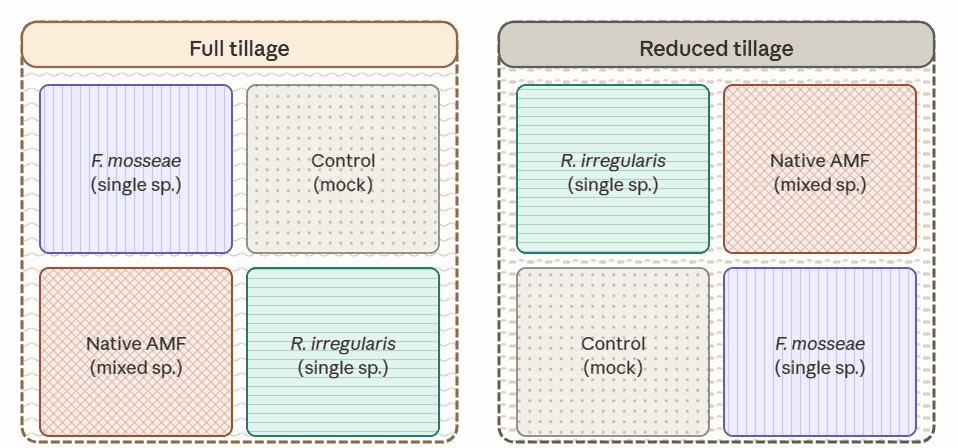
- A two-year field study was conducted at Rodale Institute (Kutztown, PA). The experimental design was a randomized split-plot design with tillage as the main plot factor and AMF as the subplot factor.
- Tillage treatments included: (1) full tillage and (2) reduced tillage.
- Arbuscular mycorrhizal fungi (AMF) treatments included:
- Funneliformis mosseae (single-species)
- Rhizophagus irregularis (single-species)
- Native AMF community (mixed species)
- Control (mock)
- AMF for the three non-control treatments were propagated in standard nursery plug cell trays containing growing media mix and colonized Bahia grass root fragments. A ‘mock’ control inoculum was prepared using Bahia grass grown in autoclaved soil.
- Organic sweet corn was seeded into trays containing each AMF inoculum in late May/early June, and 14 seedlings per AMF treatment were transplanted to respective field plots ~1 week later.
Data Collection:
- Sweet corn ears were harvested from the center-most row of each plot to estimate yield, and at harvest, ten whole plants per treatment were collected and analyzed for harvest index (HI). Fresh kernels were removed and evaluated for mineral nutrients,* total C and N, amino acid content, crude protein, and vitamins B6 and C. Roots were collected, washed, and analyzed for AMF root colonization.
-
- *Mineral nutrients included: phosphorus (P), potassium (K), calcium (Ca), magnesium (Mg), sulfur (S), manganese (Mn), iron (Fe), copper (Cu), boron (B), and zinc (Zn).
-
Key Findings
Sweet Corn Yield
- Fresh sweet corn yield was significantly influenced by tillage, with higher yields observed in the full tillage plots than in reduced tillage plots, suggesting that full tillage enhances nutrient availability through alterations to soil structure and microbial activity.
- Sweet corn yield was not significantly influenced by AMF inoculation.
Kernel Mineral Nutrient Concentration & Essential Amino Acid Content
- Concentrations of K, Ca, Mg, Mn, and B in sweet corn kernels were significantly impacted by tillage, with higher kernel nutrient levels observed in reduced tillage plots compared to full tillage plots.
-
- In general, mineral nutrients were not significantly influenced by AMF inoculation, except for the R. irregularis single-species treatment, which significantly increased P, K, and Zn concentrations and reduced B concentrations in sweet corn kernels.
-
- Tillage significantly influenced leucine and phenylalanine concentrations in sweet corn kernels, with higher levels observed in full tillage plots.
-
- AMF inoculation did not significantly influence essential amino acid concentrations.
-
Root Colonization
- AMF root colonization was slightly greater in reduced tillage plots than in full tillage plots, although the difference was not statistically significant.
- Similarly, sweet corn plants inoculated with the R. irregularis single-species AMF treatment exhibited slightly greater root colonization than the other AMF treatments, although not significantly.
Resources
Zinati, G., Carrara, J. E., Das, S., Caetani, R., Kalra, A., Carr, E. A., & Heller, W. P. (2025). Impact of tillage practices and arbuscular mycorrhizal fungi inoculation on organic sweet corn yield and nutritional quality. Soil and Tillage Research, 251, 106545.
Read MoreLocation
PennsylvaniaCollaborators
Joseph Carrara, USDA Agricultural Research Service
Saurav Das, Rodale Institute
Romans Caetani, Rodale Institute
Amiya Kalra, Purdue University
Eric Carr, Rodale Institute
Wade Heller, USDA Agricultural Research Service
Region
Northeast/Mid-Atlantic
Topic
Crop Nutrient Management, Cropping Systems
Year Published
2025